Blog Feed

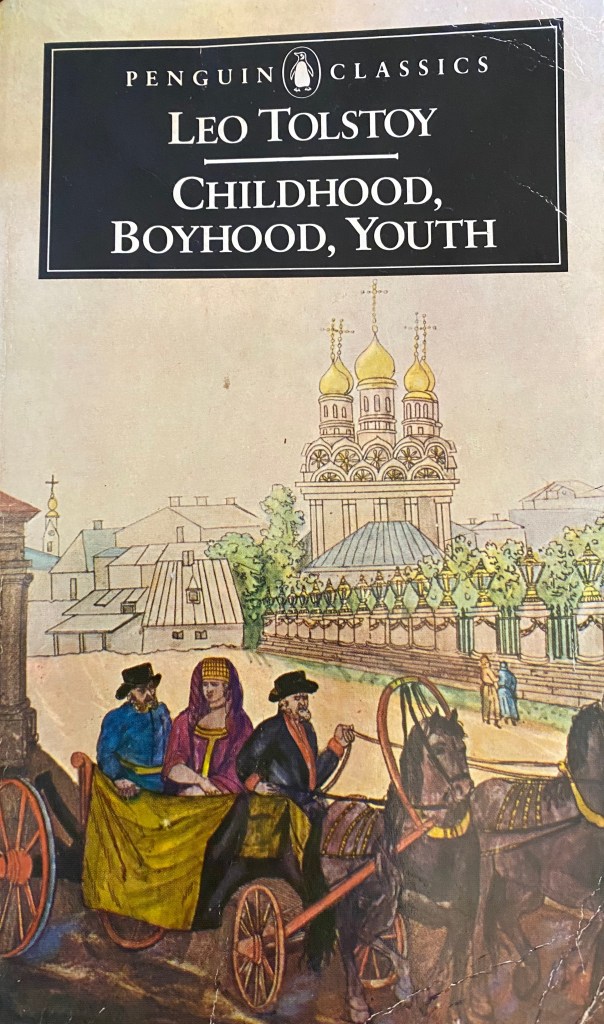
Childhood, Boyhood, Youth by Leo Tolstoy

This was my pick for Classics Club Spin #33 – the 13th I have participated in. I had assumed this book was an autobiography, but it is actually a novel, written when Tolstoy was a young man. Despite this, it is written in the first person and is clearly closely based on his own life and upbringing. I found the book really interesting in terms of the lifestyle of wealthy families in 19th century Russia, often moving between homes in Moscow and country farms, and always involving lavish parties. Characteristic of Tolstoy and especially relevant and moving in this book are the many instances detailing the main character’s inner life. There is lots of description of feelings of guilt, grief and general confusion, and lack of understanding even of his own behaviour when in situations involving some sort of social, family, academic or religious pressure – all of which are easy to relate to as universal experiences.

I hadn’t read any Tolstoy until a few years ago when I finally read Anna Karenina, followed a couple of years later by War and Peace. He writes very descriptively and I have enjoyed everything I’ve read of his, so am keen to get into the short stories, still languishing on my TBR shelf.

Classics Club Spin #33

Time for another spin. I am coming to the end of my first Classics Club challenge (read 50 classics within 5 years – only need 4 more to complete my first 50!), so am looking forward to this spin. I have chosen 20 books from my ever expanding list of owned but unread classics, and when the magic number is spun on Sunday 19 March, I will have until the end of April to read the relevant book. I have four of the following books already planned for reading for other challenges over the next few weeks, so am hoping for one of those!

Here is my list:

1The Well Dressed Explorer (Australian)Thea Astley1962
2Lorna Doone RD Blackmore1869
3The PromisePearl S Buck1944
4The Story of the Stone V2 – The Crab-Flower ClubCao Xueqin1791
5The LeopardTomasi Di Lampedusa1958
6Barnaby RudgeCharles Dickens1841
7The Three MusketeersAlexandre Dumas1844
8Mountain MadnessWinifred Fortescue1943
9My ApprenticeshipMaxim Gorky1916
10I, ClaudiusRobert Graves1934
11The Art of SeeingAldous Huxley1943
12The Portrait of a LadyHenry James1881
13The Pea-Pickers (Australian)Eve Langley1942
14Seven Pillars of WisdomTE Lawrence1922
15Intimate Strangers (Australian)Katharine Susannah Prichard1937
16Old MortalityWalter Scott1816
17The Honey Flow (Australian)Kylie Tennant1956
18Childhood, Boyhood, YouthLeo Tolstoy1852
19The WardenAnthony Trollope1855
20Piccadilly JimPG Wodehouse1916

Adam Bede

by George Eliot

This was my most recent Classics Club Spin pick. I always enjoy George Eliot – such a gifted writer and so skilled at providing character and setting. It’s now a couple of weeks since I finished it – I wanted to let it stew a while to see what aspects remained with me after reading several other books. Unusually for me, I still recall quite a lot. I have pictures in my head of several characters (though I have forgotten most of their names), and have a strong sense of the countryside and the general village life, including that of the farmers, the tradesmen, and the gentry, all of which I found quite fascinating. This is George Eliot’s genius I think. There are aspects of the book that I can see would be difficult for some readers – there is some discussion of politics and religious discord that were apparently happening at that time, and lots of dialogue spelled in a way to represent characters’ accents, which was somewhat tedious, but also interesting to me as a linguist and Speech Pathologist. The storyline is somewhat predictable, but the characters so well-drawn, with behaviours unbelievably shocking in our context, though representative of the times. Even so, all the characters can be recognised as types we would see today – the beautiful young airhead who attracts all the men but has little understanding of who would suit her, the naive but solid and caring tradesman who only sees the pretty girl and not her frivolous nature, the privileged playboy, the salt-of-the-earth farmers, etc, etc. It is good to be reminded of how far we have come socially – the lives of women in those times were especially powerless and this is made abundantly clear in this story.

A very worth-while read.

Classics Club Spin #32

Here we go again with the latest dive into my classics TBR list. With some weeks of freedom coming up I’m not too worried about which book comes up in the spin, but knowing my luck it will be a short one just when I’ve got time for one of the doorstops! I only have a few books to go to complete my first Classics Club list of 50 books, and then I will be ready to move onto another 50. For the spin, the requirement is to list 20 books before Sunday, when a random number between 1 and 20 will be posted, and I then have until the end of January to read the book listed under that number. Easy!

The titles listed here are all physical books I have on my shelves at home, some of which I have picked up fairly recently at charity shops or swap shelves, and others that have been languishing here unread for years. It’s always a nice surprise to read and enjoy a classic I’ve been putting off for a long time…

1Blackmore, RDLorna Doone 
2Cao, XueqinThe Story of the Stone V2 – The Crab-Flower Club
3Di Lampedusa, TomasiThe Leopard
4Dickens, CharlesBarnaby Rudge
5Dumas, AlexandreThe Three Musketeers
6Eliot, GeorgeAdam Bede
7Fortescue, WinifredMountain Madness
8Gorky, MaximMy Apprenticeship
9Graves, RobertI, Claudius
10Harrower, ElizabethThe Watchtower (Australian)
11Huxley, AldousThe Art of Seeing
12James, HenryThe Portrait of a Lady
13Langley, EveThe Pea-Pickers (Australian)
14Lawrence, TESeven Pillars of Wisdom
15Prichard, Katharine SusannahIntimate Strangers (Australian)
16Scott, WalterOld Mortality
17Tennant, KylieThe Honey Flow (Australian)
18Trollope, AnthonyThe Warden
19Trollope, AnthonyMiss Mackenzie
20Wodehouse, PGPiccadilly Jim

The Tenant of Wildfell Hall

by Anne Bronte

This was the book chosen for me by the most recent Classics Club Spin. I was not especially looking forward to it, but was very pleasantly surprised. I found it a very enjoyable read, and was particularly impressed by the heartfelt and devastating descriptions of dealing with a loved one suffering a self-destructive addiction. Having read much about the Brontes over the years, it was clear that Anne was writing about the experiences her family had dealing with their brother Branwell’s alcoholism. It felt like a very modern story to me, with the oafish male friendship group, and the one deciding to grow up and behave like an adult, and his subsequent bullying by the rest of the group. Anne clearly had very good insight into social pressures on both men and women of her time, and was also very angry about it!

The book is written as a series of letters and diary entries, a construction I didn’t really like, but overall I really enjoyed this book and wondered why Anne is not as well known as her sisters. I read Jane Eyre and Wuthering Heights in my teens and at least twice more over the years, as well as Villette, but had never read anything by Anne until I picked this one up at a charity shop. It was a great pick.

There are plenty of excellent reviews of this book, which is why I don’t bother to do more than give a brief description of my impressions of it – look them up on the Classics Club page!

Classics Club Spin #31

So, here we go again. I was unable to blog for the last spin (#30) because I was away and out of internet and/or phone range most of the time, but I did participate, and did finish my book, which was The Last of the Mohicans by J Fenimore Cooper. I had attempted this book previously but got bogged down and gave up, so this time was determined to finish it, and I did. It was very bloodthirsty but I did learn quite a lot, and am glad to have read it.

Anyway, on to this one. I have made my list of 20 books, and look forward to the spin happening on Sunday (tomorrow!), when I will find out which of my books I need to read by 30 October. Here is my list:

1Blackmore, RDLorna Doone 
2Bronte, AnneThe Tenant of Wildfell Hall
3Burns, RobertThe Poetical Works of Robert Burns
4Cao, XueqinThe Story of the Stone V2 – The Crab-Flower Club
5Di Lampedusa, TomasiThe Leopard
6Dickens, CharlesBarnaby Rudge
7Dumas, AlexandreThe Three Musketeers
8Eliot, GeorgeAdam Bede
9Fortescue, WinifredMountain Madness
10Gorky, MaximMy Apprenticeship
11Harrower, ElizabethThe Watchtower
12Huxley, AldousThe Art of Seeing
13Langley, EveThe Pea-Pickers
14Lawrence, TESeven Pillars of Wisdom
15Prichard, Katharine SusannahIntimate Strangers
16Scott, WalterOld Mortality
17Tennant, KylieThe Honey Flow
18Trollope, AnthonyThe Warden
19Trollope, AnthonyMiss Mackenzie
20Wyss, Johann DavidThe Swiss Family Robinson

Classics Club Spin #29

(#9 for me)

Gosh these spins seem to come around quickly, but I always enjoy them. Since the last spin I have read two more from my Classics Club list, but never seem to get around to blogging about them. Anyway, for this spin I have chosen 20 books from my list, and when the random number spin happens on Sunday 20 March (tomorrow), I find that number on my list and will need to read that book by April 30. There are some very long ones on this list, so I post it with some trepidation! Here is my list:

1Blackmore, RDLorna Doone 
2Bronte, AnneThe Tenant of Wildfell Hall
3Burns, RobertThe Poetical Works of Robert Burns
4Cao, XueqinThe Story of the Stone V2 – The Crab-Flower Club
5Cooper, FenimoreThe Last of the Mohicans
6Di Lampedusa, TomasiThe Leopard
7Dickens, CharlesBarnaby Rudge
8Dumas, AlexandreThe Three Musketeers
9Eliot, GeorgeAdam Bede
10Fortescue, WinifredMountain Madness
11Gaskell, ElizabethNorth and South
12Graves, RobertI, Claudius
13Harrower, ElizabethThe Watchtower
14Langley, EveThe Pea-Pickers
15Lawrence, TESeven Pillars of Wisdom
16Prichard, Katharine SusannahIntimate Strangers
17Prichard, Katharine SusannahCoonardoo
18Trollope, AnthonyThe Warden
19Trollope, AnthonyMiss Mackenzie
20Wyss, Johann DavidThe Swiss Family Robinson

The Trumpet-Major

by Thomas Hardy

This was the book chosen for me to read for the Classics Club Spin #28, and I really enjoyed it. I read all the best-known Thomas Hardy books in my teens, and it is many years since I have reread any, so I was delighted to find this one at a charity shop, and to add it to my Classics Club list. I have managed to read quite a few from my list this year, and this book represents #32 of the 50 I have pledged to read before August 2024, so I am well on track!

The Trumpet-Major is one of several main characters in this novel, set during the Napoleonic period, when the locals of a small coastal village are worried about invasion. The story revolves around a young woman who is the love interest of 3 young men, only one of whom actually deserves her, but of course she falls for the charmer. One of the men is completely odious, but the girl’s mother prefers him because he is likely to come into money, whereas the other two (brothers) are poor miller’s sons. As always with classics, it is interesting (though depressing) to read about social behaviour that was apparently acceptable at that time – in this case stalking and assault that the man apparently thought would win him the love of a girl who was clearly unwilling.

The thing that I really enjoyed about this book was the humour – Hardy is such a clever writer and his descriptions of the characters and their behaviours were so relatable to people we might know today, despite the very different social climate, and I often found myself smiling. Hardy is not known for his humour – in fact I think of his books as generally depressing – so I am keen to reread some as I am sure I was not as aware of the quality of his writing when I read the books many years ago. This was a good find.

Classics Club Spin #28

This will be my 8th Classics Club Spin, and I have been successful with all except the very first. It is a great way to motivate yourself to read some of those classics that have sat on the shelf for far too long.

The idea is to list 20 classics still on the TBR, and then wait – on On Sunday 17th, October, a number from 1 through 20 will be posted, and the challenge is to read whatever book falls under that number on my Spin List by the 12th December, 2021. That’s an eight week reading window for this spin. A couple of times I have had to read the very longest book on my list (War & Peace and Tom Jones), so I am leaving the really long ones off this list as I know I will be very busy over the lead-up to the end of the year. Here is my list…

1AnonymousBeowulf
2Blackmore, RDLorna Doone 
3Buchan, JohnThe Thirty-Nine Steps
4Burns, RobertThe Poetical Works of Robert Burns
5Di Lampedusa, TomasiThe Leopard
6Dickens, CharlesBarnaby Rudge
7Dumas, AlexandreThe Three Musketeers
8Eliot, GeorgeAdam Bede
9Forster, EMA Passage to India
10Gaskell, ElizabethNorth and South
11Graves, RobertI, Claudius
12Hardy, ThomasThe Trumpet-Major
13Harrower, ElizabethThe Watchtower
14Hugo, VictorNotre-Dame of Paris
15Maugham, W SomersetOf Human Bondage
16Stark, FreyaAlexander’s Path
17Sun TzuThe Art of War
18Trollope, AnthonyThe Warden
19Trollope, AnthonyMiss Mackenzie
20Wyss, Johann DavidThe Swiss Family Robinson

Robinson Crusoe

by Daniel Defoe

This was the book I was challenged to read as a result of the Classics Club Spin #27. I was slightly nervous about it as there are so many bad reviews on Goodreads, and several ‘ho-hum’ reviews in the Classics Club archives. Some complaints are about the archaic language, but as I read lots of classics I quite enjoyed this aspect, and it was originally published in 1719 after all – more than 300 years ago! Though quite slow to start, I did enjoy the book overall. Once Robinson is shipwrecked on the island (which takes quite a while to happen), it is absorbing to read of his inventive and dogged attempts to make a safe home and devise sustainable sources of food, which followed very quickly from his initial despair and hopelessness. I was surprised at the many, many years he stayed alone on the island, and I felt that his paranoia about the possibility of encountering other people was interesting, as most stories about shipwrecked people show them as desperate to attract attention. It was many years before he saw anyone at all, and I did enjoy the section after he first sees a footprint, leading him to further anxiety and manic building of further defences. Once Man Friday becomes part of his life, things move fairly quickly and he moves from being terrified and defensive, to becoming a strong and confident leader. One of the best aspects of the book is Defoe’s ability to demonstrate Crusoe’s character, though this book really only has one character – all the others are very incidental and not really developed at all. As many have mentioned, the end is rather an anticlimax, but overall I enjoyed the book and am glad to have read it.